Pages

Showing posts with label Talam and Layam. Show all posts

Wednesday, December 05, 2012

100 Years - A Tribute


This is the centenary year of several legends like T.Brinda, Palghat Mani Iyer, Madurai Mani Iyer, T.K.Rangachari, etc. and the hundredth year of the living maestro Dr.Pinakapani. To observe the centenay year of these stalwarts, functions are held by their students, relatives and rasikas as a mark of respect and remembrance.

If an artist's centenary year is celebrated, it is because he has scaled heights and is far above the average. Otherwise, a centenary year would not have been observed. If these artists have reached such a level, it is because of the efforts they have put in, their hard work, focus and determination that took them to the top.

The aim of the centenary celebration should not be just to inform the public that these artists would have turned 100, but on the contrary, to make their efforts and contribution known to today's generation, with an aim that the youngsters look upon these maestros as role models and try to emulate them and follow the path shown by them.

This kind of emulation would itself be a true mark of homage to these vidwans and a means of paying respect to their soul.

Saturday, August 01, 2009

Manavati


Manavati : It is the 5th Melakarta rāgam in the 72 melakarta rāgam system of Carnatic music.

In Muthuswami Dikshitar school of Carnatic music, the 5th melakarta is Manoranjani. This scale uses the notes shuddha rishabham, shuddha gandharam, shuddha madhyamam, chathusruthi dhaivatham, kakali nishadham

Raga Structure:
Arohanam: S R1 G1 M1 P D2 N3 S
Avarohanam: S N3 D2 P M1 G1 R1 S

Tala Structure (20 Aksharams):


1 Laghu + 1 Dhrutha Viraamam + 1 Anudhruthams + 1 Laghu + 1 Anudhrutham + 1 Laghu + 1 Dhrutha Viraamam

4+3+1+4+1+4+3 = 20 Aksharams

Monday, July 20, 2009

Vanaspati


Vanaspati : It is the 4th Melakarta ragam in the 72 melakarta ragam system of Carnatic music.

This ragam is also called Bhānumati in Muthuswami Dikshitar school of Carnatic music. The notes used in this scale are Shuddha rishabham, shuddha gandharam, shuddha madhyamam, chathusruthi dhaivatham and kaisiki nishadham.

Raga Structure:
Arohanam: S R1 G1 M1 P D2 N2 S
Avarohanam: S N2 D2 P M1 G1 R1 S

Tala Structure (22 Aksharams):
1 Laghu + 2 Anudhruthams + 1 Guru + 1 Anudhrutham + 1 Laghu + 1 Dhrutha Viraamam
4+2+8+1+4+3 = 22 Aksharams

Saturday, July 18, 2009

Ganamurti - gānamūrti

Ganamurti : It is the 3rd Melakarta rāgam in the 72 melakarta rāgam system of Carnatic music.
This ragam is also called Gānasāmavarāḷi in Muthuswami Dikshitar school of Carnatic music. The notes used in this scale are shuddha rishabham, shuddha gandharam, shuddha madhyamam, shuddha dhaivatham, kakali nishadham.
Arohaṇam: S R1 G1 M1 P D1 N3 S
Avarohaṇa: S N3 D1 P M1 G1 R1 S

Tala Structure ( 22 Aksharams) :
1 Laghu + 2 Anudhruthams + 1 Laghu + 1 Dhrutha Viraamam + 1 Guru + 1 Anudhrutham
4+2+4+3+8+1 = 22 Aksharams

Ratnangi - ratnāngi

ratnāngi : It is the second melakartha ragam in the 72 melakartha system of carnatic music.

This ragam is also called Phenadhyuti in Muthuswami Dikshitar school of Carnatic music. The scale uses the notes shuddha rishabham, shuddha gandharam, shuddha madhyamam, shuddha dhaivatham and kaisiki nishadham.

Raga Structure:

Arohanam : S R1 G1 M1 P D1 N2 S
Avarohanam : S N2 D1 P M1 G1 R1 S


Tala Structure ( 20 Aksharams) :

1 Guru + 1 Anudhrutham + 1 Laghu + 1 Dhrutha Viraamam + 1 Laghu
8 + 1 + 4 + 3 + 4 = 20 Aksharams


Kanakangi - Kanakāngi

Kanakāngi : It is the first melakartha ragam in the 72 melakartha system of carnatic music.

This ragam is also called as Kāshirāmakriya in the Muthuswami Dikshitar school of carnatic music. The scale uses the notes shuddha rishabham, shuddha gandharam, shuddha madhyamam, shuddha dhaivatham, shuddha nishadham.


Raga Structure:
Arohanam : S R1 G1 M1 P D1 N1
Avarohanam : S N1 D1 P M1 G1 R1

Tala Structure ( 15 Aksharams) :

Kanakangi - 15 Aksharams
1 Anudhrutham + 1 Dhrutham + 1 Guru + 1 Laghu
1 + 2 + 8 + 4 = 15 Aksharams


Monday, September 29, 2008

Analysis - IV

Starting time : 4:35
Ending Time : 6:17

As seen in the previous post, shifting from one nadai to another nadai can be done in different ways. He mani sir has chosen a simple method. Taking a syllable of 8 mathrai playing the same in chatursram and tisram.

In simple words, if you play a syllable of 8, 2 times in 4 Aksharams (16 mathrais), it should be played 3 times in 4 Akshrams (24 mathrais). This is what he is doing from minute 5:00 to 5:28. The korvai starts @ 5:30. The Korvai is defined for 1.5 Avarthanams (2 kalai) / 3 avarthanams (1 Kalai) or 24 Aksharams of chatursram,which is 32 * 3 = 96 Matharais.

while converting the same into tisram, this comes to 1 Avarthanams(2 kalai) or 2 Avarthanams (1 kalai) or 16 aksharams or 48 * 2 = 96 Mathrais. The 48 is nothing but, 6 mathrais per aksharam (1 beat) and aditalam comprises of 8 beats its is 8 * 6 gives you 48.

The korvai is structured as into two parts. The first part is set to 8 Aksharams and the second part is set for 9 aksharams for thisram, if it has to played for chatursram, the same thing will fit into 10.5 aksharams and 13.5 Aksharams.


There is lot of scope of improvising this particular korvai. In the diagram, I have drawn two lines, vertical and horizontal. The uthrangam (finalpart) of the korvai can be played either horizontally or vertically, since the average is 18.

Next we will see about harishankar's thisram.

Saturday, September 27, 2008

Analysis - III

It is continued by a thisra nadai by mani sir. I would like to add few of my view points in this area. There are different ways of converting from one nadai to another nadai. To my knowledge the following is some of the ways it can be shifted.

1. Starting thisram staright from the word GO
2. Starting thisram by playing a small syllable then shifting gears
3. Play a korvai in chatursram and convert the same into thisram
4. Play thisram in terms but not showing the nadai.
5. Just play a korvai in thisram

We can never say which one of the above mentioned is the thumb rule, it purely depends on time. If you are in Air, if you are a 3 minutes thani, you can never play thisram elaborately. In this thani avarthanam, you will find 2 ways of handling conversion from one nadai to another nadai.

Manisir will be taking chatursram Syllable as a base and do vinyasam on the same, play same korvai in chatursram and thisram, where as Harishankar will Play a BIGGGGGG korvai playing the same 2 times in chatursram and finally converting the same into thisram.

We are familiar with composers of songs, but a special note should be made on the korvai harishankar has played. The composer of the korvai was mani sir. He composed it especially for harishankar for the Sruthi laya Thaniavarthan Series (1980). Harishankar has handled the korvai as if its made only for him. Many will feel that its not a tough korvai, but it requires lot of memory power and control over the laya. We will see more about the korvai when we see Harishankar's extra-ordinary thisram section.

Friday, September 26, 2008

Analysis - I

The tala chosen for analysis is Aadi talam 2 Kalai, Arai Edam (atheetha eduppu). The pallavi starts 1 beat(4 mathrais) before the samam. Once you follow the thani avarthanam with the talam religiously you will know why I am calling this as atheetha eduppu.

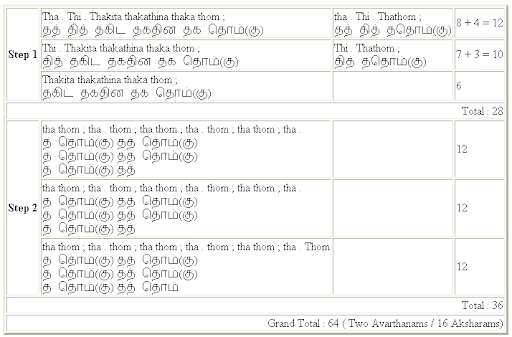
The first round of thaniavarthanam looks like net practice - warming up for a big one. After playing 4 syallables in chatursram, mani sir takes 24 (12 in fast tempo) mathrai syllable for a small korvai. You cant call this as a korvai, we can call this as abhiprayam. I have seen many people calling this as a korvai and many people calling this as Abhiprayam (Abhiprayam differs ;-)).

Though the abhiprayam looks simple its a bit confusing. The abhiprayam is constructed in the following way. First lets see the structure and then the abhiprayam as syllables.

Part 1 :
Step 1 : First syllable for 3 Aksharams - 12 Matharis ( splitted as 8 and 4 )
Step 2 : Second Syllable for 2.5 Aksharams - 10 Mathrais ( splitted as 7 and 3 )
Step 3 : Third Syllable for 1.5 Aksharams – 6 Mathrais.

Total comes to 28 Mathrais or 7 Aksharams. (Since its chatursram, a beat consists of 4 mathrais, it comes to 7 Aksharams)

Part 2:
A balance of 36 matharis or 9 aksharams is pending. Now this 9 is divided into 3 parts. A 3 akshram syllable is taken as arithi which constitutes this Abhiprayam.


Harishankar started of few fast phased syllables and played a simple abhiprayam for 3 Avarthanams. The structure of the Abhiprayam is very simple, but a simple change made it sounds better.

The strucutre needs no diagrams a its a straigh forward abhiprayam, if you dont understand I will give more details on this.

6 3 , 6 3, 6 3 - 27
8 3 , 8 3 ,8 3 - 33
10 3, 10 3, 10 - 36

the total comes to 96. which comes for 3 Avarthanams. Six can be played as Thatheekitathom, 8 as thaka Thatheekitathom and 10 as thakathina Thatheekitathom.


Thursday, September 25, 2008

Thani Avarthanam - I

Here is ONE of the best thani by Mani sir and G.Harishankar. It’s been long time since I wanted to write about the thanis of mani sir somehow it didn’t happen. I don’t know how many of you have this recording with you. I am uploading the same for the sake of people who don’t have it.

The idea behind writing about thani is, often in many forums I see people saying… “I don’t understand anything, but I like it”….

The first step I am doing here is giving you the link to download the thani, if you want to hear it online, you can do it. The below given links will help you.

Enjoy the scintillating thani
Download : Thani Avarthanam

Listen Online

Sunday, January 18, 2004

Mere sound is not Layam!

Nobody goes to concert to enjoy just sound however pleasing it may be. Creativity & aesthetic sense are a must for any music. A concert should provide a mridangist a good opportunity to present his creativity & aesthetic sense.

I have been saying for quite some time that to experience the magnificence of Layam, audience are yet to be educated. They cannot identify what is being played in a Thani as they identify a Raga or Krithi. The same Ragas or Krithis they have become familiar with for years are easily identified. As for the Laya section, theycan, at the most, say that the Mridangam had a good tonal quality, it was electrifying, vibrating, scintillating, etc. But they cannot realise the content. We should accpt thst only from the times of Pudukottai Dhakshinamoorthy Pillai, Palghat Mani Iyer & Palani Subramanya Pillai, the audience have been attracted towards Mridangam & othe percussion instruments. Today, we briefly explain what we are going to do in a Thani Avarthanam concert. By this brief explanation before a Thani Avarthanam concert, we are preparing the audience to understand the intricacies of Laya. Only now Thani Avarthanam concerts are gaining ground. But it will take time to create a longing for a long Thani. The advocacy of short Thani is intended to keep the expectation of audience alive.

Appreciate Mridangam Playing

After two-and-a-half hours of playing, Mridangam loses its tonal quality. The mridangist becomes physically tired & exhausted. The audience too need a break after hearing continous music. They are thus forced to stretch or go out for a brief walk & refreshment. However great be the performer, the ability to make the audience sit through & enjoy the Thani, with all the above mentioned disadvantages around, is a big question mark.

Sunday, January 11, 2004

Full of Jargon

anga namesymbolaksharakaalasmovement
anudrutamU1beat with palm
drutam02beat with palm + turn (wave)
druta viramamU03 (2 + 1)drutam + anudrutam
laghu|(#)4 (or 3,5,7,9)beat + finger counts
laghu viramamU|5 (4+1)laghu + anudrutam
laghu drutam0|6 (4+2)laghu + drutam
laghudruta viramamU0|7 (4+2+1)laghu + drutam + anudrutam
guru88wave to left and rightor circle with thumb-up
guru viramamU88 (8+1)guru + anudrutam
guru drutam0810 (8+2)guru + drutam
gurudruta viramamU0811 (8+2+1)guru + drutam + anudrutam
plutam|812 (8+4)beat + wave to sides
pluta viramamU|813 (12+1)plutam + anudrutam
pluta drutam0|814 (12+2)plutam + drutam
pluta druta viramamU0|815 (12+2+1)plutam + drutam + anudrutam
kaakapaadam+16beat plus wave up and to sides

Percussion, Rhythm, and TaaLam

The mridangam artist is an expert at keeping the taaLam correctly and will often indicate the samam of the taaLam or the beginning of a musical phrase by movement in addition to showing the sequence of beats. Carnatic rhythm may be complicated but by practice in keeping taaLam to music correctly and understanding the underlying principles, it can be very satisfying to appreciate the melody as well as the rhythm of the music.

KaLai & EDuppu

KaLai
Another term is kaLai, which refers to using multiple beats in one beat. Thus 2nd kaLai of aadi taaLam will use 2 beats for every one beat of the taaLam. This is noticeable in the speed of the song and the length of the aavartanam (cycle of the taaLam).

EDuppuIn some cases, the taaLam doesn't "begin" on the beginning of the first beat (called the samam). It may begin just 1/2 beat before or after, or 1 1/2 beat after, for example. The place where a particular section of a song (anupallavi, pallavi, or charaNam) begins in the taaLam is called the graham or eDuppu.

m u s i c

Music is an extremely subjective, aural experience. Some sounds are perceived by us as pleasant and some others as unpleasant. What is considered pleasant or unpleasant can be quite personal, based on our specific culture, exposure to particular kinds of music and perhaps even on what our parents told us. A song could be a major hit in one country and could be completely disliked and ignored in some other country. Our musical tastes are indeed developed. As we grow up, and discover music from other cultures or newer musical styles, our tastes too change. Sometimes, we even discover a pleasant piece of music purely by accident - because it simply happened to resonate with our inner sensibilities. Oh, nothing like self discovery ! Or Can we say
Minute Understanding Of Sound In Creation
An equally interesting exercise - think of five songs you really like. Can you explain why you like them or what is in common with all of them ? Can you 'explain' and define your musical taste ? Unfortunately, however much analysis one does, in terms of frequencies and so forth, it finally boils down to psychological factors when it comes to music and taste. Analysis is merely a tool to understand some of its structure. It can never explain why some musical sounds are deemed 'romantic' or 'harsh' or why some ragam is an evening ragam (if you believe in such things). Such mystique about music will come back to haunt us and will forever prevent us from understanding its totality in an objective manner.

Marga & Chanda Talams

Apart from the desi talas, there are other set of talas called "Marga Talas". These talas, in addition to the angams in the desi talas - laghu, drtham and anudrtham have other angams called Guru, Plutham, Kakapadam. The 108 talas and other groups of talas come under this group.

1 Guru - 1 beat and counting 7 fingers
1 Plutham - 1 beat, 1 krshyai & 1 sarpini
1 Kakapadam - 1 beat, 1 krshyai, 1 sarpini & 1 pathakam
1 krshyai - waving the hand towards left, it has 4 aksharams
1 sarpini - waving the hand towards right, it has 4 aksharams
1 pathakam - raising the hand vertically, has 4 aksharams

These talas are complicated and are found in very few compositions. In fact, the music of Tamils in ancient times had complicated rythm patterns like Chandha talam. Rythm was given importance. The Thiruppugazh is a classic example of the variety and complex nature of tala pattern in Carnatic music. The uniqueness of this tala lies in the fact that it varies according to the stress and rhyme-patterns (called Chanda) in the Tiruppugazh.

An example of a tala that uses all the units mentioned so far is Simhanandana tala, the longest tala, with 128 units.

Rhythmic Aspects

The rhythmic aspects in Carnatic music are arguably among the most developed and sophisticated across the world. The patterns range from the simple to the complex. The study of rhythmic aspects involves understanding the terms Tala and Laya.

Tala and Laya
Tala is often confused with Laya. Laya refers to the inherent rhythm in anything. Irrespective of whether it is demonstrated or not, it is always present. This can be better illustrated with an example. We know that the sun, the planets and other heavenly bodies are moving objects. Even as our earth rotates on its axis and revolves around the sun, these bodies have their own fixed movements and speeds. Even a microscopic disturbance in that speed may lead to disasters of huge proportions. So laya can be explained as the primordial orderliness of movements. Expression of laya in an organised fashion through fixed time cycles is known as Tala. Thus it serves as the structured rhythmic meter to measure musical time-intervals. Tala in Carnatic music is usually expressed physically by the musician through accented beats and unaccented finger counts or a wave of the hand. In other words, Tala is but a mere scale taken for the sake of convenience.

Saturday, January 10, 2004

Appreciating Laya

Rhythm is omnipresent. There is rhythm in the movement of heavenly bodies just as in the life cycles of micro organisms. It is only natural that man is endowed with it. Whenever we listen to music, we look for the rhythmic movements in it and then find ourselves tapping our feet or clapping our hands or even dancing to it. But what exactly do we mean by rhythm?
Rhythm can be defined as a process in which the nuclei of attention are separated by individual parts of time. Whenever we listen to music, we cannot but perceive rhythm. Rhythm gives stability and form to music. It can be described as the tangible gait of any musical movement. In Carnatic music, this is referred to as Laya. The common fallacy is that rhythm or laya is confined to percussion instruments and the rhythmic patterns produced therein. But laya is not limited to just that. It is present not only in melodic compositions, which usually have a rhythmic metre in an apparent manner but also in the creative aspects, sometimes conspicuously (like in Neraval or Kalpanaswara) and subtly at others (Raga alapana and Tanam).