Pages

Showing posts with label 72 Melakartha. Show all posts

Saturday, August 01, 2009

Manavati


Manavati : It is the 5th Melakarta rāgam in the 72 melakarta rāgam system of Carnatic music.

In Muthuswami Dikshitar school of Carnatic music, the 5th melakarta is Manoranjani. This scale uses the notes shuddha rishabham, shuddha gandharam, shuddha madhyamam, chathusruthi dhaivatham, kakali nishadham

Raga Structure:
Arohanam: S R1 G1 M1 P D2 N3 S
Avarohanam: S N3 D2 P M1 G1 R1 S

Tala Structure (20 Aksharams):


1 Laghu + 1 Dhrutha Viraamam + 1 Anudhruthams + 1 Laghu + 1 Anudhrutham + 1 Laghu + 1 Dhrutha Viraamam

4+3+1+4+1+4+3 = 20 Aksharams

Monday, July 20, 2009

Vanaspati


Vanaspati : It is the 4th Melakarta ragam in the 72 melakarta ragam system of Carnatic music.

This ragam is also called Bhānumati in Muthuswami Dikshitar school of Carnatic music. The notes used in this scale are Shuddha rishabham, shuddha gandharam, shuddha madhyamam, chathusruthi dhaivatham and kaisiki nishadham.

Raga Structure:
Arohanam: S R1 G1 M1 P D2 N2 S
Avarohanam: S N2 D2 P M1 G1 R1 S

Tala Structure (22 Aksharams):
1 Laghu + 2 Anudhruthams + 1 Guru + 1 Anudhrutham + 1 Laghu + 1 Dhrutha Viraamam
4+2+8+1+4+3 = 22 Aksharams

Saturday, July 18, 2009

Ganamurti - gānamūrti

Ganamurti : It is the 3rd Melakarta rāgam in the 72 melakarta rāgam system of Carnatic music.
This ragam is also called Gānasāmavarāḷi in Muthuswami Dikshitar school of Carnatic music. The notes used in this scale are shuddha rishabham, shuddha gandharam, shuddha madhyamam, shuddha dhaivatham, kakali nishadham.
Arohaṇam: S R1 G1 M1 P D1 N3 S
Avarohaṇa: S N3 D1 P M1 G1 R1 S

Tala Structure ( 22 Aksharams) :
1 Laghu + 2 Anudhruthams + 1 Laghu + 1 Dhrutha Viraamam + 1 Guru + 1 Anudhrutham
4+2+4+3+8+1 = 22 Aksharams

Ratnangi - ratnāngi

ratnāngi : It is the second melakartha ragam in the 72 melakartha system of carnatic music.

This ragam is also called Phenadhyuti in Muthuswami Dikshitar school of Carnatic music. The scale uses the notes shuddha rishabham, shuddha gandharam, shuddha madhyamam, shuddha dhaivatham and kaisiki nishadham.

Raga Structure:

Arohanam : S R1 G1 M1 P D1 N2 S
Avarohanam : S N2 D1 P M1 G1 R1 S


Tala Structure ( 20 Aksharams) :

1 Guru + 1 Anudhrutham + 1 Laghu + 1 Dhrutha Viraamam + 1 Laghu
8 + 1 + 4 + 3 + 4 = 20 Aksharams


Kanakangi - Kanakāngi

Kanakāngi : It is the first melakartha ragam in the 72 melakartha system of carnatic music.

This ragam is also called as Kāshirāmakriya in the Muthuswami Dikshitar school of carnatic music. The scale uses the notes shuddha rishabham, shuddha gandharam, shuddha madhyamam, shuddha dhaivatham, shuddha nishadham.


Raga Structure:
Arohanam : S R1 G1 M1 P D1 N1
Avarohanam : S N1 D1 P M1 G1 R1

Tala Structure ( 15 Aksharams) :

Kanakangi - 15 Aksharams
1 Anudhrutham + 1 Dhrutham + 1 Guru + 1 Laghu
1 + 2 + 8 + 4 = 15 Aksharams


Friday, September 26, 2008

Analysis - I

The tala chosen for analysis is Aadi talam 2 Kalai, Arai Edam (atheetha eduppu). The pallavi starts 1 beat(4 mathrais) before the samam. Once you follow the thani avarthanam with the talam religiously you will know why I am calling this as atheetha eduppu.

The first round of thaniavarthanam looks like net practice - warming up for a big one. After playing 4 syallables in chatursram, mani sir takes 24 (12 in fast tempo) mathrai syllable for a small korvai. You cant call this as a korvai, we can call this as abhiprayam. I have seen many people calling this as a korvai and many people calling this as Abhiprayam (Abhiprayam differs ;-)).

Though the abhiprayam looks simple its a bit confusing. The abhiprayam is constructed in the following way. First lets see the structure and then the abhiprayam as syllables.

Part 1 :
Step 1 : First syllable for 3 Aksharams - 12 Matharis ( splitted as 8 and 4 )
Step 2 : Second Syllable for 2.5 Aksharams - 10 Mathrais ( splitted as 7 and 3 )
Step 3 : Third Syllable for 1.5 Aksharams – 6 Mathrais.

Total comes to 28 Mathrais or 7 Aksharams. (Since its chatursram, a beat consists of 4 mathrais, it comes to 7 Aksharams)

Part 2:
A balance of 36 matharis or 9 aksharams is pending. Now this 9 is divided into 3 parts. A 3 akshram syllable is taken as arithi which constitutes this Abhiprayam.
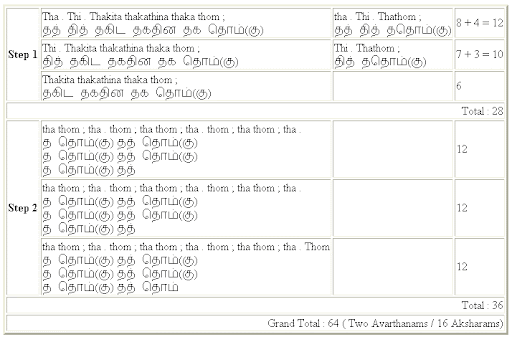


Harishankar started of few fast phased syllables and played a simple abhiprayam for 3 Avarthanams. The structure of the Abhiprayam is very simple, but a simple change made it sounds better.

The strucutre needs no diagrams a its a straigh forward abhiprayam, if you dont understand I will give more details on this.

6 3 , 6 3, 6 3 - 27
8 3 , 8 3 ,8 3 - 33
10 3, 10 3, 10 - 36

the total comes to 96. which comes for 3 Avarthanams. Six can be played as Thatheekitathom, 8 as thaka Thatheekitathom and 10 as thakathina Thatheekitathom.


Thursday, September 25, 2008

Shifting Scales - II

We are interested in obtaining one scale from another scale. One way to get one scale from another scale is to rearrange the intervals. The interval between the 1st and the 2nd note may be made short and the interval between the 2nd and the 3rd note may be made long. For example from the scale of the 29th mela Sankarabharanam, if the scale of Kharaharapriya has to be obtained, then the interval between the notes R and S is shortened, the interval between N AND S is lengthened and so on.

If the major scale of the western music is taken into account, and if the whole lock stock and barrel of the scale is shifted from C to G, then F sharp is obtained. The process by which a scale can be obtained from another scale, is the process of modal shift of tonic. Here the mode is retained. In other words the sequence of the intervals is retained. It must be remembered, that the tonic or the aahara sadja alone is not shifted. 

Take for example, the scale of Sankarabharanam. It is S R2 G2 M1 P D2 N2 S. In this scale, if the Aadhara sadja, is shifted to the position of rsabha and if the interval between the svaras are maintained, then a new scale is obtained. Here only the scale is taken into account and not the raga. This is due to the fact that in carnatic music, each raga has the shape of its own, due to the various type of gamakas employed.

Shifting Scales - I

The word “scale”, means an ordered presentation of notes abstracted from any melody, put in a particular order, may be in the ascending order.In South Indian music, it will be in terms of svarasthaanas. If we say C scale or D scale, they are just that set of seven notes because they just take part in melody. In the 72 - mela scheme, all the 72 are scales. 

Scales may be having seven, six or five notes, put in order.  Modal shift of tonic is the process by which the tonic or the Aadhara sadja is shifted from svara to svara, keeping the sequence of the intervals of the original scale in tact. This process gives new scale.  In common music language this process is known as the Grahabhedam.  In ancient tamil music, this process was known as Kural tiribu, Pannuppeyarttal and Paalai Pannal.