Pages

Showing posts with label Analysis. Show all posts

Monday, September 29, 2008

Analysis - IV

Starting time : 4:35
Ending Time : 6:17

As seen in the previous post, shifting from one nadai to another nadai can be done in different ways. He mani sir has chosen a simple method. Taking a syllable of 8 mathrai playing the same in chatursram and tisram.

In simple words, if you play a syllable of 8, 2 times in 4 Aksharams (16 mathrais), it should be played 3 times in 4 Akshrams (24 mathrais). This is what he is doing from minute 5:00 to 5:28. The korvai starts @ 5:30. The Korvai is defined for 1.5 Avarthanams (2 kalai) / 3 avarthanams (1 Kalai) or 24 Aksharams of chatursram,which is 32 * 3 = 96 Matharais.

while converting the same into tisram, this comes to 1 Avarthanams(2 kalai) or 2 Avarthanams (1 kalai) or 16 aksharams or 48 * 2 = 96 Mathrais. The 48 is nothing but, 6 mathrais per aksharam (1 beat) and aditalam comprises of 8 beats its is 8 * 6 gives you 48.

The korvai is structured as into two parts. The first part is set to 8 Aksharams and the second part is set for 9 aksharams for thisram, if it has to played for chatursram, the same thing will fit into 10.5 aksharams and 13.5 Aksharams.


There is lot of scope of improvising this particular korvai. In the diagram, I have drawn two lines, vertical and horizontal. The uthrangam (finalpart) of the korvai can be played either horizontally or vertically, since the average is 18.

Next we will see about harishankar's thisram.

Saturday, September 27, 2008

Analysis - III

It is continued by a thisra nadai by mani sir. I would like to add few of my view points in this area. There are different ways of converting from one nadai to another nadai. To my knowledge the following is some of the ways it can be shifted.

1. Starting thisram staright from the word GO
2. Starting thisram by playing a small syllable then shifting gears
3. Play a korvai in chatursram and convert the same into thisram
4. Play thisram in terms but not showing the nadai.
5. Just play a korvai in thisram

We can never say which one of the above mentioned is the thumb rule, it purely depends on time. If you are in Air, if you are a 3 minutes thani, you can never play thisram elaborately. In this thani avarthanam, you will find 2 ways of handling conversion from one nadai to another nadai.

Manisir will be taking chatursram Syllable as a base and do vinyasam on the same, play same korvai in chatursram and thisram, where as Harishankar will Play a BIGGGGGG korvai playing the same 2 times in chatursram and finally converting the same into thisram.

We are familiar with composers of songs, but a special note should be made on the korvai harishankar has played. The composer of the korvai was mani sir. He composed it especially for harishankar for the Sruthi laya Thaniavarthan Series (1980). Harishankar has handled the korvai as if its made only for him. Many will feel that its not a tough korvai, but it requires lot of memory power and control over the laya. We will see more about the korvai when we see Harishankar's extra-ordinary thisram section.

Friday, September 26, 2008

Analysis - II

Starting time : 2:26
Ending time : 4:35

Let me take the Chatursram 2nd round of Mani sir.
Started with the usual 6 syllable, Kita tha ka thaka thom thom ka (2nd speed).
The abhiprayam is structured as the first part decreasing from 5, 4, 3 with the second half increasing from 1,2,3.

The total Mathrais for the abhiprayam is 99. It is splitted into 3 halfs, the first half will be for 31 mathrais and the second one for 34 mathrais and the final one for 34 mathrais. The mathrais are including of the karvais (gaps) that is given between the 1st, 2nd and 3rd part.

After that, it’s a free flow Chatusra Sarva laghu with different varieties. I don’t think any explanation required for this part alone.

Analysis - I

The tala chosen for analysis is Aadi talam 2 Kalai, Arai Edam (atheetha eduppu). The pallavi starts 1 beat(4 mathrais) before the samam. Once you follow the thani avarthanam with the talam religiously you will know why I am calling this as atheetha eduppu.

The first round of thaniavarthanam looks like net practice - warming up for a big one. After playing 4 syallables in chatursram, mani sir takes 24 (12 in fast tempo) mathrai syllable for a small korvai. You cant call this as a korvai, we can call this as abhiprayam. I have seen many people calling this as a korvai and many people calling this as Abhiprayam (Abhiprayam differs ;-)).

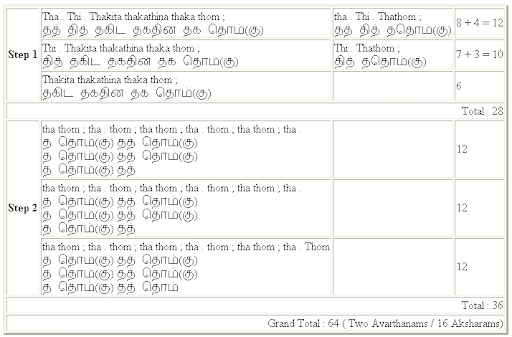
Though the abhiprayam looks simple its a bit confusing. The abhiprayam is constructed in the following way. First lets see the structure and then the abhiprayam as syllables.

Part 1 :
Step 1 : First syllable for 3 Aksharams - 12 Matharis ( splitted as 8 and 4 )
Step 2 : Second Syllable for 2.5 Aksharams - 10 Mathrais ( splitted as 7 and 3 )
Step 3 : Third Syllable for 1.5 Aksharams – 6 Mathrais.

Total comes to 28 Mathrais or 7 Aksharams. (Since its chatursram, a beat consists of 4 mathrais, it comes to 7 Aksharams)

Part 2:
A balance of 36 matharis or 9 aksharams is pending. Now this 9 is divided into 3 parts. A 3 akshram syllable is taken as arithi which constitutes this Abhiprayam.


Harishankar started of few fast phased syllables and played a simple abhiprayam for 3 Avarthanams. The structure of the Abhiprayam is very simple, but a simple change made it sounds better.

The strucutre needs no diagrams a its a straigh forward abhiprayam, if you dont understand I will give more details on this.

6 3 , 6 3, 6 3 - 27
8 3 , 8 3 ,8 3 - 33
10 3, 10 3, 10 - 36

the total comes to 96. which comes for 3 Avarthanams. Six can be played as Thatheekitathom, 8 as thaka Thatheekitathom and 10 as thakathina Thatheekitathom.